
Emergency Lighting and Exit Sign Service in the Bay Area
When the power goes out, your exit signs and egress lighting are the only thing standing between your occupants and a dark building. California requires those systems to activate automatically, to stay lit long enough for a full evacuation, and to be tested on a fixed schedule with written records. Batteries fail quietly, which is exactly why the testing requirement exists.
What California requires
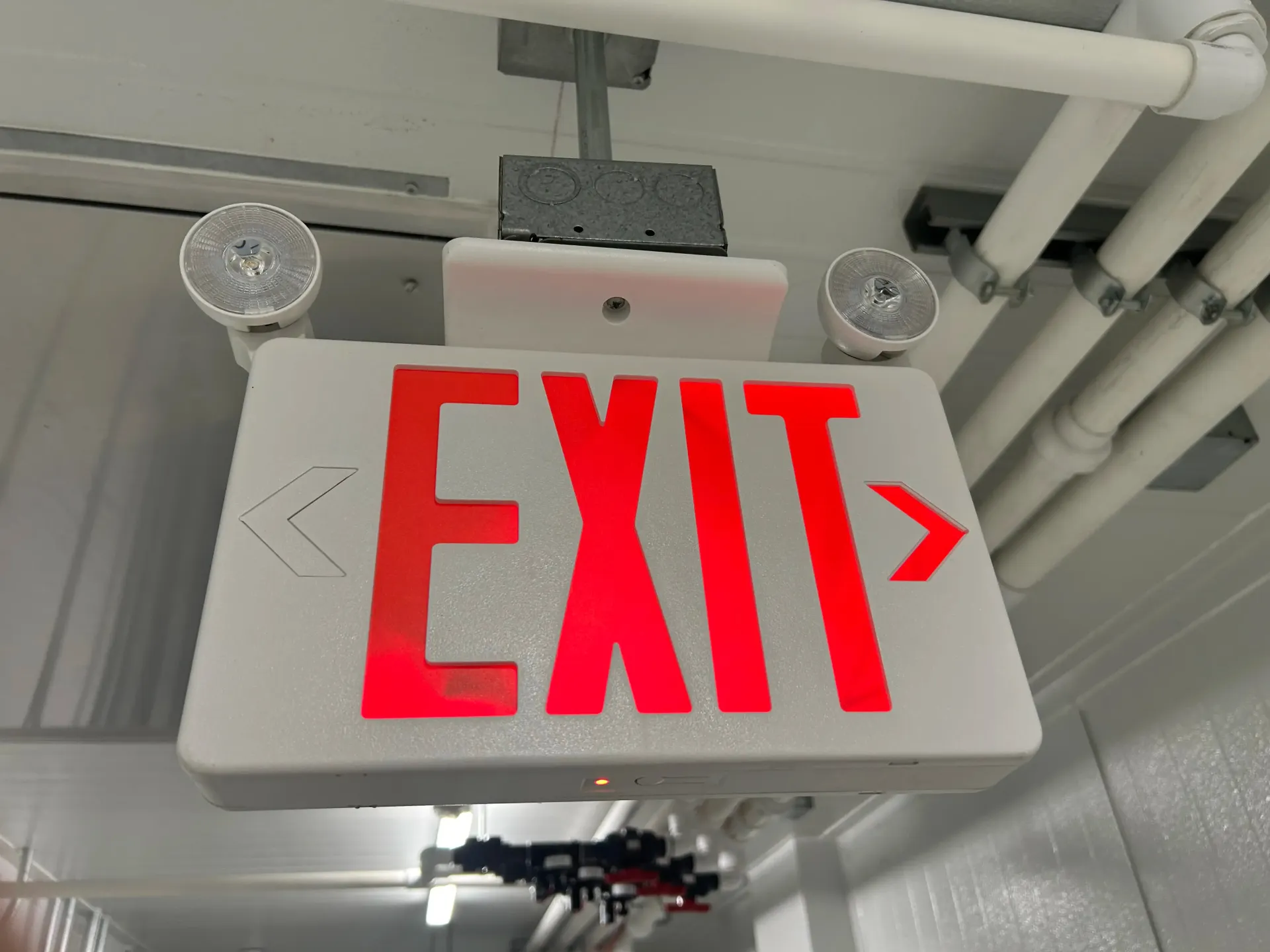
Title 24 mandates emergency illumination, including exit signs and lighting along the path of egress, during a power outage or other emergency. A few specifics matter:
- Emergency and exit lighting must activate automatically during a power failure. No manual intervention.
- Lighting must be arranged so that a single failed bulb does not leave any area in total darkness.
- Exit signs must be legible, illuminated, and equipped with backup power from batteries or a generator, and they must stay visible during an outage.
Illumination levels
Egress lighting has to deliver measurable light at floor level, not just somewhere in the room:
- Initial average illumination of at least 10.8 lux, which is 1 foot-candle.
- A minimum of at least 1.1 lux at any point along the path of egress.
- Specified allowable decline over the duration of the emergency, since batteries lose output as they discharge.
Lux is the standard SI unit for illuminance, meaning the amount of light landing on a surface. One lux equals one lumen per square meter. The practical point is that a fixture can look like it is working, yet still fail to put usable light on the floor where people are walking.
Required testing schedule
The Life Safety Code sets the cadence, and both tests have to be documented in writing:
| Test | Frequency | What it confirms |
|---|---|---|
| 30-second functional test | Monthly | The unit switches over to battery power and the lamps illuminate |
| 90-minute operational test | Annually | The battery holds output for a full 90 minutes, which is the duration required for evacuation |
The annual 90-minute test is the one that catches failing batteries. A unit can pass a 30-second test and die minutes later while an emergency evacuation is still in progress.
Battery and system requirements
- Batteries must be rechargeable and of an approved type.
- The system has to handle frequent test and discharge cycles without requiring a manual reset.
- Backup power has to be in place for every exit sign, whether from an onboard battery or a building generator.
What we do
- Inspect emergency lighting units and exit signs throughout your facility
- Run the annual 90-minute battery operational test
- Test batteries and circuits
- Certify compliant units and document the results for your records
- Repair or replace failed fixtures, batteries, and signs
- Show your staff how to run the monthly 30-second test and keep the log
Building a compliance plan
Emergency lighting belongs on the same compliance calendar as your extinguishers. We schedule inspections, testing, and service together, and we help you build the employee exit plan that Title 24 assumes you already have.