
Fire Extinguisher Inspections and Tagging in the Bay Area
California does not treat fire extinguisher inspection as optional. Every business is required to check its extinguishers monthly and have them professionally serviced and tagged once a year. Bayside Fire Protection handles the annual side, comes to your site, inspects every unit, tags it, and documents the work so you have the paperwork ready when an inspector or an insurance adjuster asks for it.
What California actually requires
Two separate sets of rules apply to your extinguishers, and they are easy to confuse:
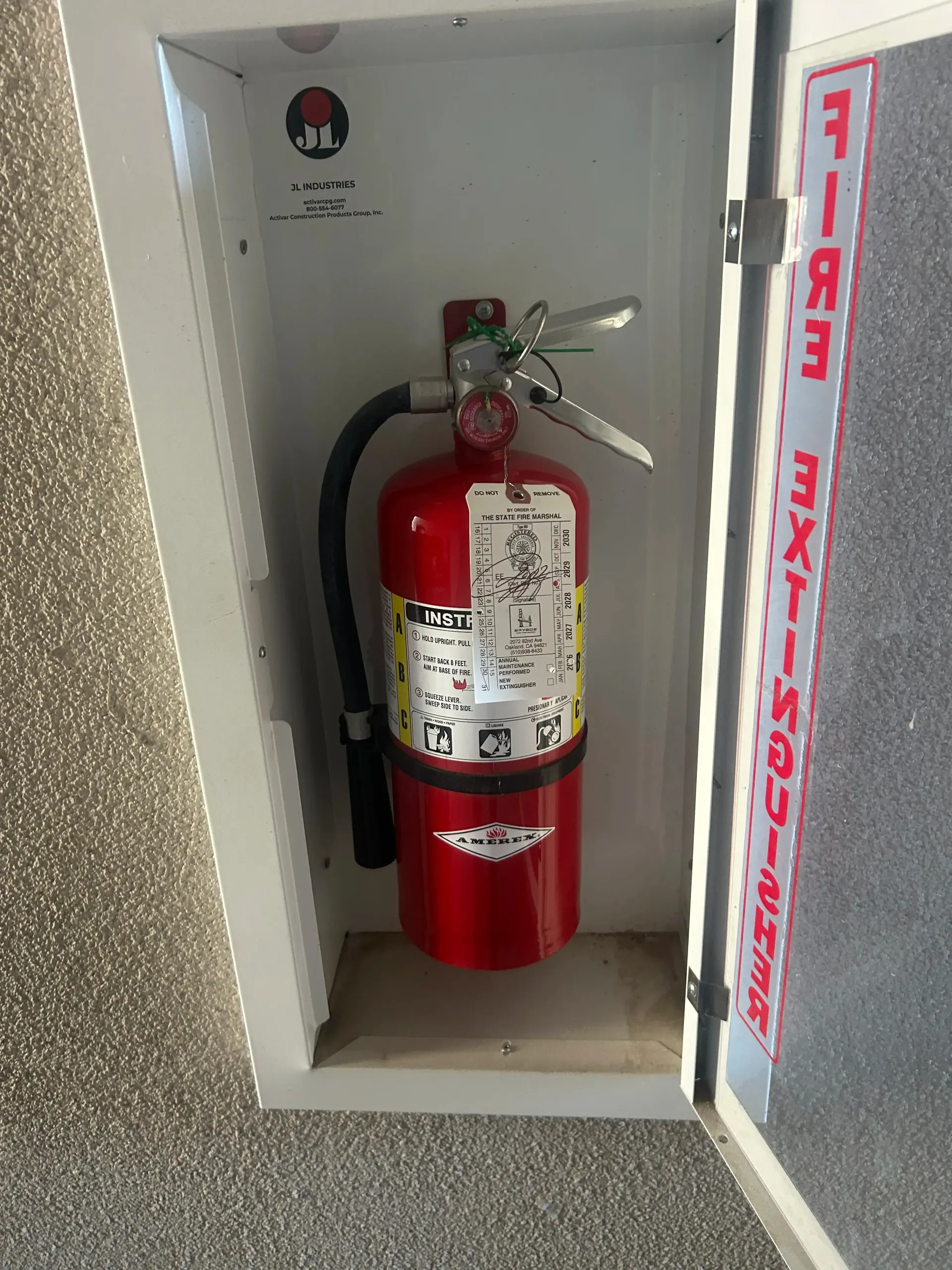
- Title 8, Section 6151 of the California Code of Regulations is the Cal/OSHA standard. It puts the duty on you as the employer. Your extinguishers must be fully charged, operable, and in correct locations at all times. You must perform a monthly visual inspection, record any deficiencies, and correct them. Annual maintenance and periodic hydrostatic testing are mandated.
- Title 19 covers the servicing side. The company that services and tags your extinguishers has to hold a valid Certificate of Registration from the California State Fire Marshal. Bayside Fire Protection is licensed by the State Fire Marshal, License #4799.
In practice: the monthly check is your responsibility, the annual service has to be done by a licensed technician, and both have to be documented.
Your monthly visual inspection
The monthly check takes less than a minute per extinguisher and does not require a technician. We show clients exactly what to look at:
- Check the gauge. The needle should sit in the green.
- Look over the cylinder, handle, hose, and gauge for damage.
- Confirm the pull pin and tamper seal are intact.
- Confirm the extinguisher is in its correct location, securely mounted, visible, and not blocked by inventory, equipment, or furniture.
- Sign the back of the tag.
Any deficiency you find has to be recorded and remedied. If something looks wrong, call us and we will handle it.
What we do during your annual service
- Verify pressure and confirm the unit is fully charged and operable.
- Inspect all mechanical components, seals, and the tamper seal.
- Check the cylinder, valve, handle, hose, and gauge for damage or wear.
- Confirm the extinguisher is the right type and rating for the hazard in that area.
- Review placement, mounting, travel distance, and visibility. Cabinet installation and placement.
- Tag the unit with the current service date and document the work.
- Flag any unit approaching its hydrostatic test interval or the end of its service life. Recharging and servicing.
Why compliance matters
Legal risk
Cal/OSHA, the Office of the State Fire Marshal, and local fire authorities can all issue penalties for noncompliance. Employers are most frequently cited for three things: placement, maintenance records, and training.
Safety
An unmaintained extinguisher is not just useless, it can be dangerous. Units can fall off improper mounts or fail under pressure. An extinguisher nobody has looked at in three years is the one that does not work when it matters.
Insurance
Missing documentation or lapsed service can void coverage. Carriers ask for service records after a fire, not before.
Business continuity
A well-maintained system protects your building, your inventory, your neighbors, and the vehicles in your lot. A working extinguisher in the first thirty seconds of a fire is the difference between an incident report and a total loss.
Building a compliance plan
If you have more than a handful of extinguishers, or more than one location, you need a plan rather than a calendar reminder. We help clients set one up:
- Schedule inspections, annual service, hydrostatic testing, and staff training on a single calendar. Training and demonstrations.
- Work with a vendor licensed by the Office of the State Fire Marshal so your service records hold up.
- Keep documentation organized, accessible, and available on request by authorities.
We track your service dates and send annual reminders so a surprise inspection never catches you off guard. Your emergency lighting and exit signs belong on the same calendar.
Most common fires we see
Stovetop fires, electrical fires, a cigarette in a trash can, and dryer lint fires. These are all very common – and thankfully all of them are survivable with a charged extinguisher within reach.